What's the Best Way to Map the Sub-Regions of the Human Thalamus?
A Systematic Comparison of Structural-, Structural Connectivity-, and Functional Connectivity-Based Thalamus Parcellation Techniques
Iglehart, C., Monti, M., Cain, J. A., Tourdias, T., Saranathan, M.
What's the Point?
This methods paper systematically compares structural, diffusion-MRI, and functional-connectivity approaches for dividing the human thalamus into sub-regions. The goal is practical guidance for researchers choosing a parcellation strategy for their specific target and question.
The thalamus is a tiny hub of many sub-regions that each connect to different parts of the brain. Researchers use MRI to divide it up (parcellate it), but there are many competing methods and it wasn't clear which to trust.
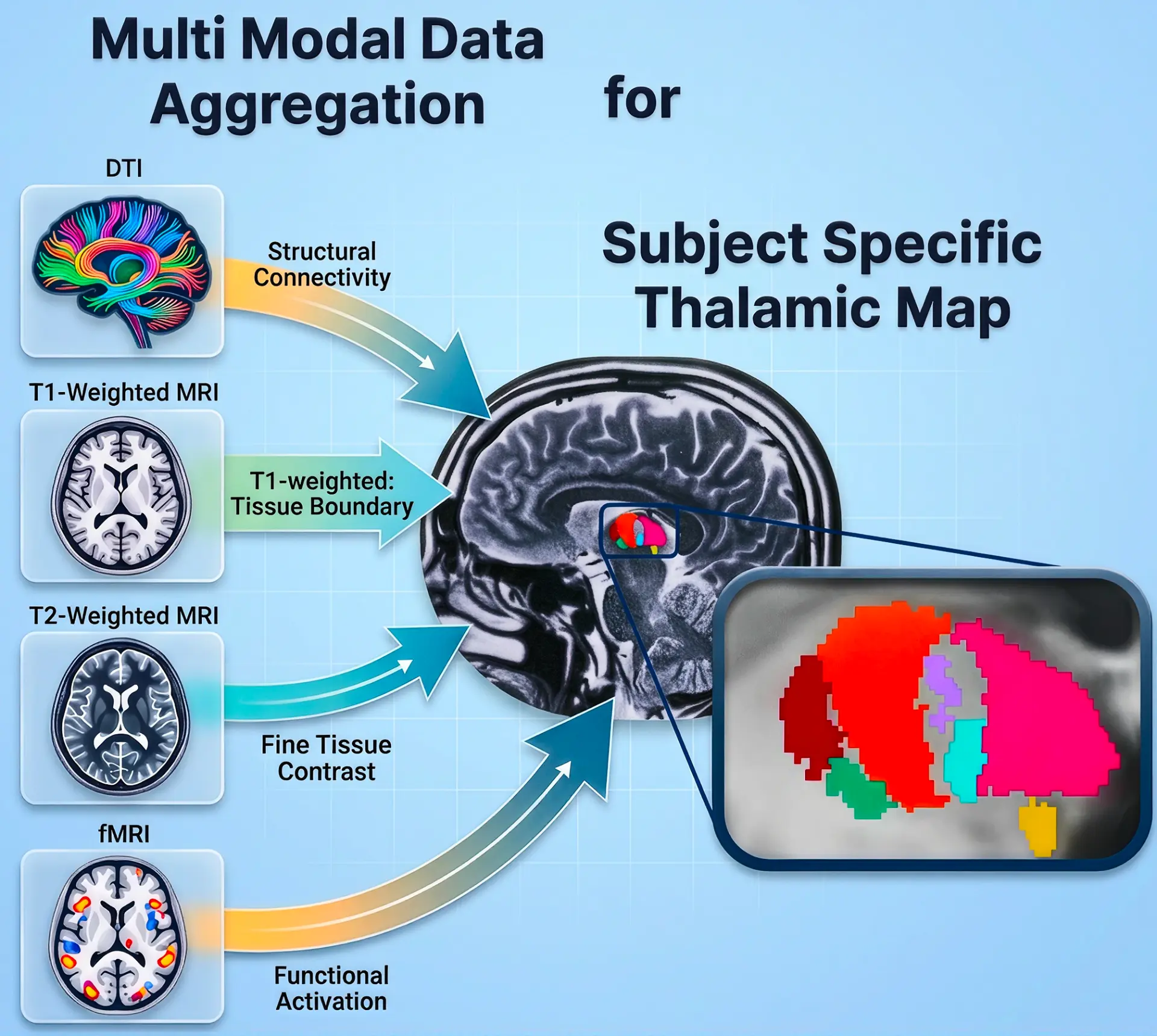
We systematically compared structural, structural-connectivity (diffusion MRI), and functional-connectivity parcellation approaches on the same human MRI data.
Diffusion-based methods excelled for larger nuclei, while functional connectivity better captured smaller substructures. No single approach dominated for every use case.
Provides concrete practical guidance for choosing thalamic parcellation methods depending on the target sub-region and the scientific question.
From the manuscript
We systematically compare structural, structural-connectivity (diffusion MRI), and functional-connectivity based thalamus parcellation methods on human MRI data. Diffusion-based methods perform best for larger nuclei, while functional-connectivity approaches better capture smaller substructures. The paper offers practical guidance for choosing parcellation strategies in thalamic research.


- Thalamus
- Neuroimaging Methods
- Methods
Infographic summarizing methods compared and key findings.
Full citation
Iglehart, C., Monti, M., Cain, J. A., Tourdias, T., & Saranathan, M. (2020). A systematic comparison of structural-, structural connectivity-, and functional connectivity-based thalamus parcellation techniques. Brain Structure and Function, 225, 1631–1642.