Can Focused Ultrasound to the Thalamus Help Reawaken the Injured Brain?
Thalamic Sonication in Chronic Disorders of Consciousness: A Mechanistic Single-Arm Clinical Trial
Martin M. Monti, Amber R. Hopkins, Norman M. Spivak, Joshua A. Cain, Jeannette Gumarang, David Patterson, Emily R. Rosario, Caroline Schnakers
What's the Point?
This clinical trial tests whether a single session of focused ultrasound aimed at the central thalamus can causally change the behavioral, brain-wave, and metabolic signatures of chronic disorders of consciousness. Sixteen patients were tracked across a 10-day inpatient protocol with behavioral exams, EEG, PET imaging, and sleep recordings.
After a severe brain injury, some patients remain in a disorder of consciousness—awake but largely unaware. The central thalamus, a deep relay hub for arousal and awareness, is a promising target, but no study had tested whether stimulating it could causally move the well-validated biomarkers of these conditions.
Sixteen adults with a chronic disorder of consciousness completed a 10-day inpatient protocol. Each received a single session of low-intensity focused ultrasound aimed at the left central thalamus. Behavioral exams (CRS-R), brain waves (EEG), glucose metabolism (¹⁸F-FDG PET), and overnight sleep recordings were collected before and after sonication.
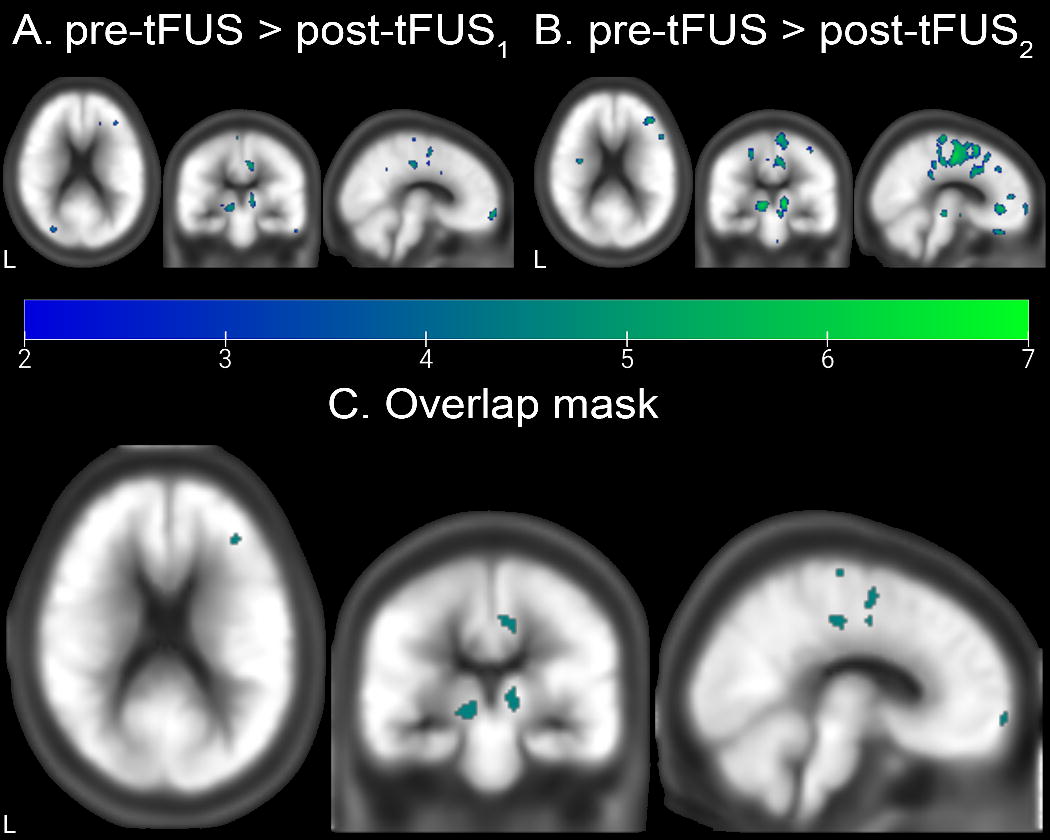
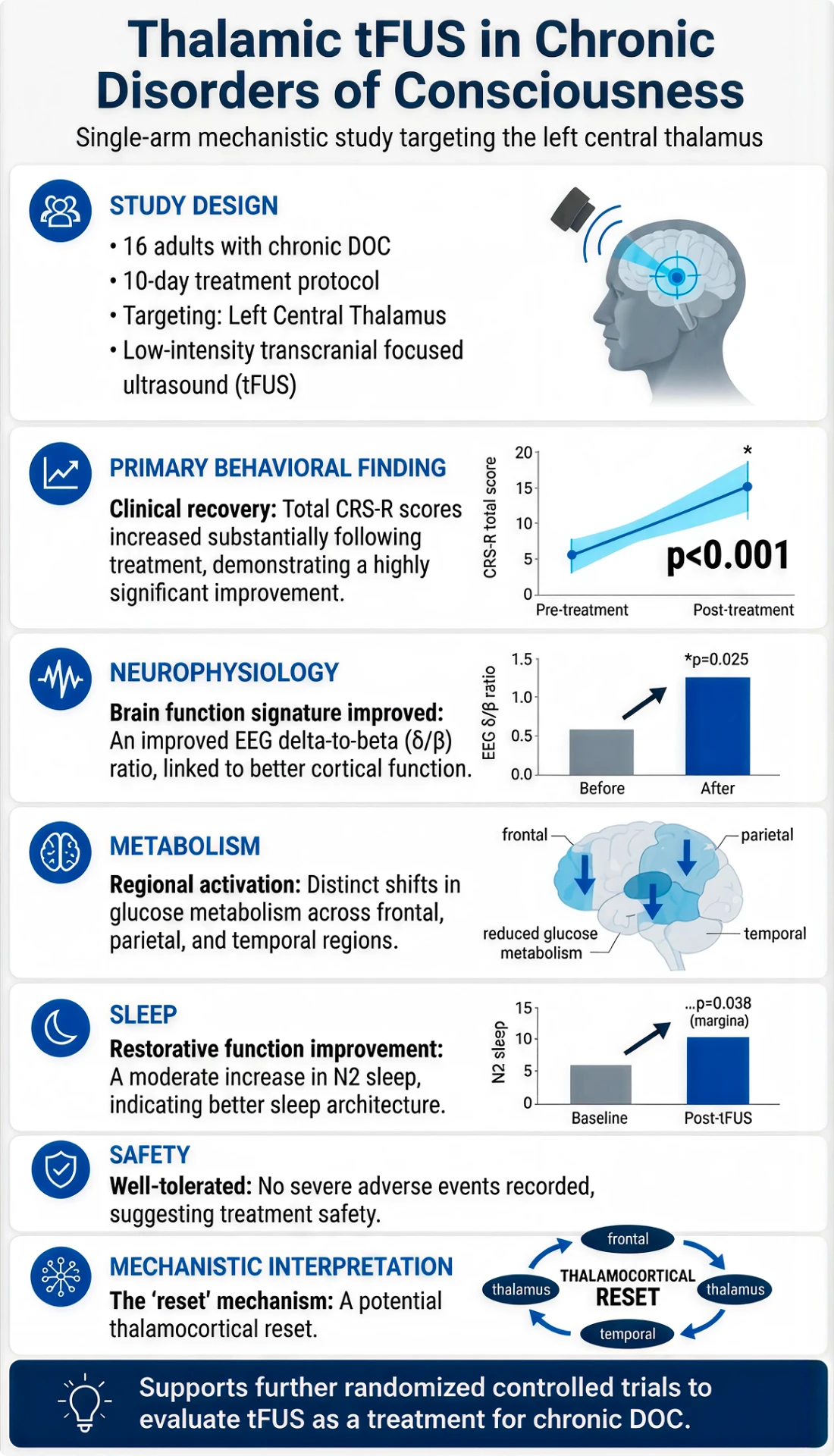
After sonication, behavioral responsiveness (CRS-R) increased significantly, and the EEG delta/beta ratio—a key consciousness biomarker—improved, with frontal slowing predicting the largest behavioral gains. Glucose metabolism decreased across the thalamus and frontal, temporal, and parietal cortices, and restorative N2 sleep rose by 33%. No severe adverse events occurred.
This is the first causal evidence that thalamic focused ultrasound can move multiple validated biomarkers of consciousness at once. The convergent pattern points to a thalamocortical reset mechanism—complementing excitatory approaches—and lays the mechanistic groundwork for a large, randomized sham-controlled trial.
From the manuscript
Background: Thalamic low-intensity transcranial focused ultrasound (tFUS) has shown promise for increasing behavioral responsiveness in disorders of consciousness (DOC), but no study has examined whether it can causally modulate the well-validated behavioral, electrophysiological, and metabolic biomarkers of DOC impairment. Methods: Sixteen adult patients with a chronic DOC secondary to severe brain injury underwent a 10-day inpatient, longitudinal, single-arm, open-label protocol. tFUS was delivered in a single session targeting the left central thalamus. Well-known behavioral (CRS-R), electrophysiological (EEG δ/β ratio), metabolic (18F-FDG PET), and polysomnographic outcomes were assessed at baseline and after sonication. Results: The maximum CRS-R total score increased significantly following tFUS compared to baseline, as did the global EEG δ/β ratio, with the degree of frontal slowing positively predicting behavioral gains. Glucose metabolism decreased bilaterally in thalamus and frontal, temporal, and parietal cortices at both post-tFUS timepoints compared to baseline. Finally, N2 sleep increased by 33% following tFUS, though this did not survive correction. No severe adverse events were observed. Conclusion: Thalamic tFUS can causally modulate well-validated behavioral, electrophysiological, and metabolic biomarkers of DOC. The convergent inhibitory signature across these measures suggests a thalamocortical reset mechanism, complementing existing excitatory neuromodulation approaches and providing the mechanistic foundation for a large, randomized sham-controlled trial.
- Disorders of Consciousness
- Focused Ultrasound
- Thalamus
- Clinical Trial
- Consciousness
- Neuroimaging
Study overview: design, behavioral, neurophysiological, metabolic, sleep, and safety outcomes of thalamic tFUS in chronic DOC.
Full citation
Monti, M. M., Hopkins, A. R., Spivak, N. M., Cain, J. A., Gumarang, J., Patterson, D., Rosario, E. R., & Schnakers, C. (2026). Thalamic sonication in chronic disorders of consciousness: a mechanistic single-arm clinical trial. medRxiv (preprint).