What Happens in the Brain When Ultrasound Is Focused on Deep Structures?
Real Time and Delayed Effects of Subcortical Low Intensity Focused Ultrasound
Cain, J. A., Visagan, S., Johnson, M. A., Crone, J., Blades, R., Spivak, N. M., Shattuck, D. W., Monti, M. M.
What's the Point?
This study uses simultaneous MRI to measure how low-intensity focused ultrasound changes activity and perfusion in deep brain structures of healthy volunteers. It provides the first group-level evidence that subcortical focused ultrasound neuromodulation produces measurable effects in the human brain.
Focused ultrasound can reach deep brain structures non-invasively, but until now there was no group-level MRI evidence that it actually changes activity in those regions in humans.
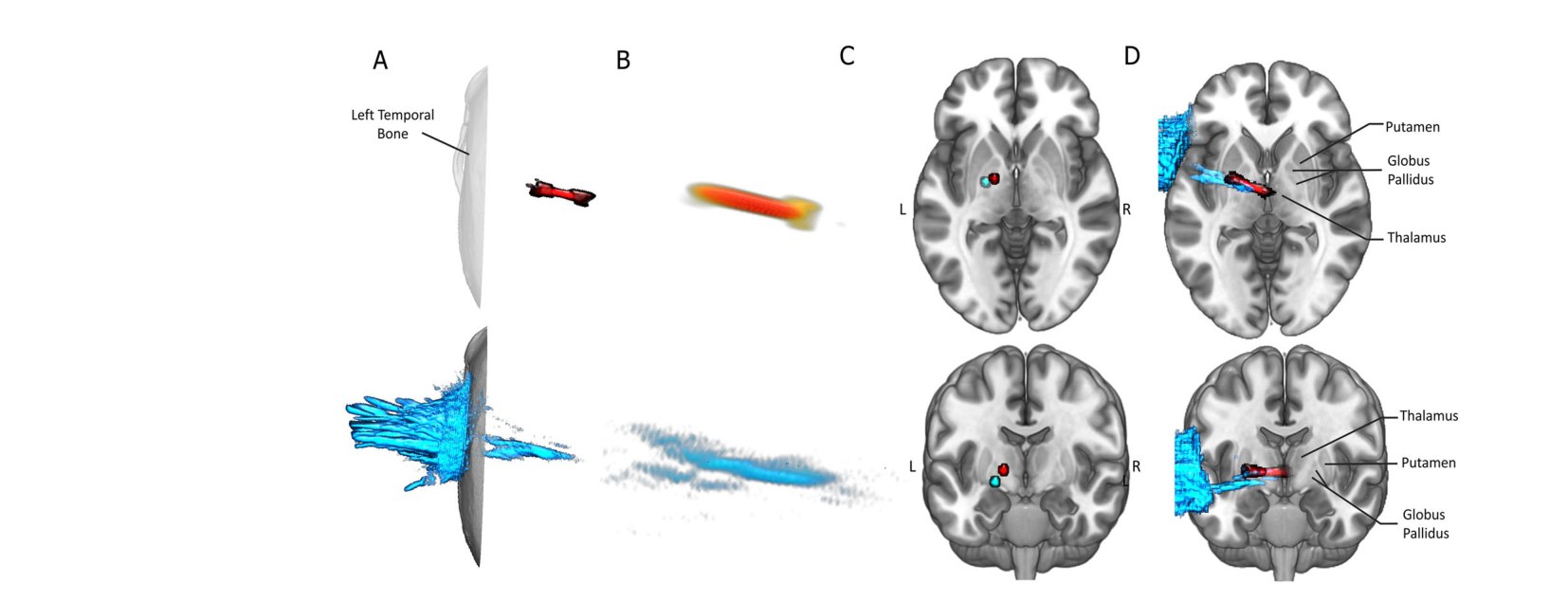
Healthy volunteers received low-intensity focused ultrasound to subcortical targets while undergoing fMRI and arterial spin labeling, so we could measure both real-time activity and delayed perfusion changes.
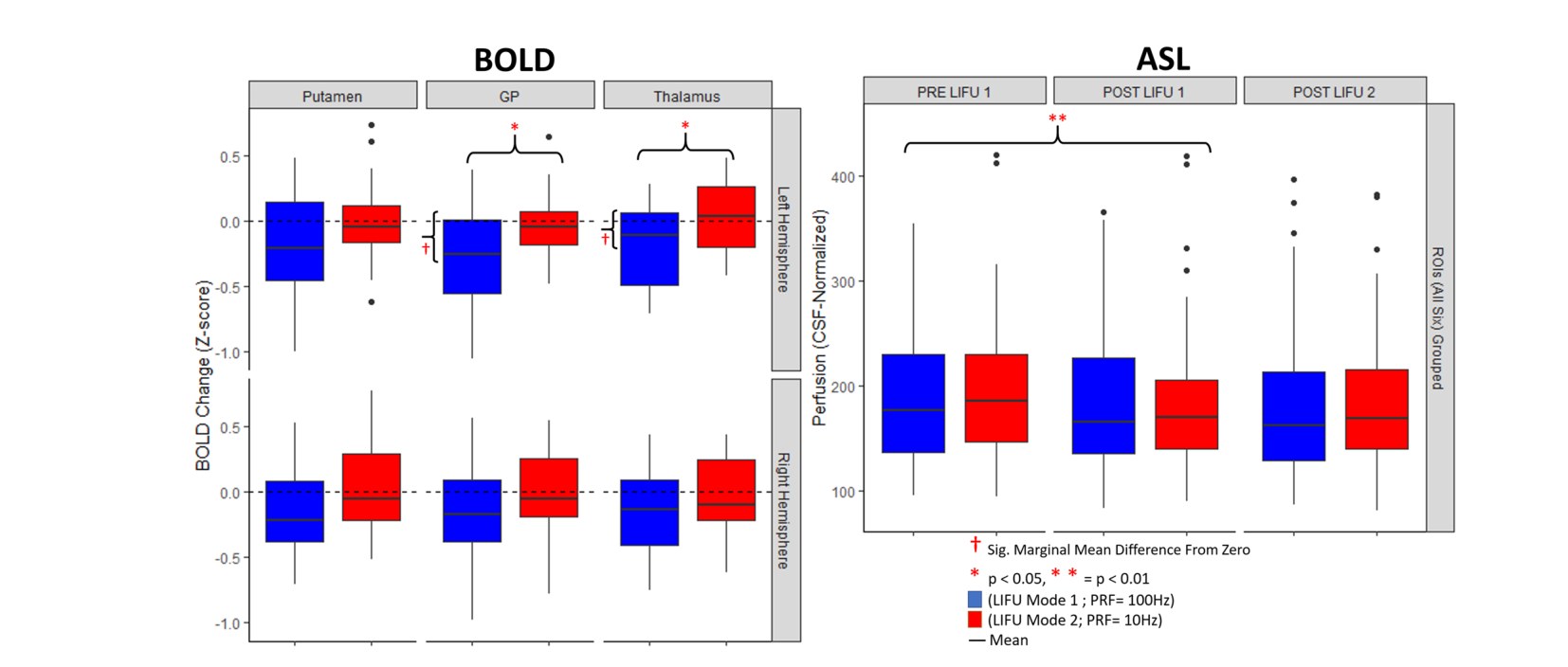
Different ultrasound parameter sets produced distinct online BOLD changes in the globus pallidus, thalamus, and cortical networks. Whole-brain perfusion changed with a delay, separating online from offline neuromodulatory effects.
First group-level demonstration of subcortical focused ultrasound neuromodulation in humans—foundational evidence for using ultrasound to causally probe deep brain circuits.
From the manuscript
In a group of healthy volunteers, we used simultaneous MRI to measure the real-time and delayed effects of low-intensity focused ultrasound aimed at subcortical structures. Different sonication parameter sets produced distinct online BOLD changes in the globus pallidus, thalamus, and cortical networks, while whole-brain perfusion shifted on a delayed timescale, dissociating online and offline neuromodulatory effects. This provides the first group-level MRI evidence of subcortical focused ultrasound neuromodulation in humans.
- Focused Ultrasound
- Human Neuroscience
- Methods
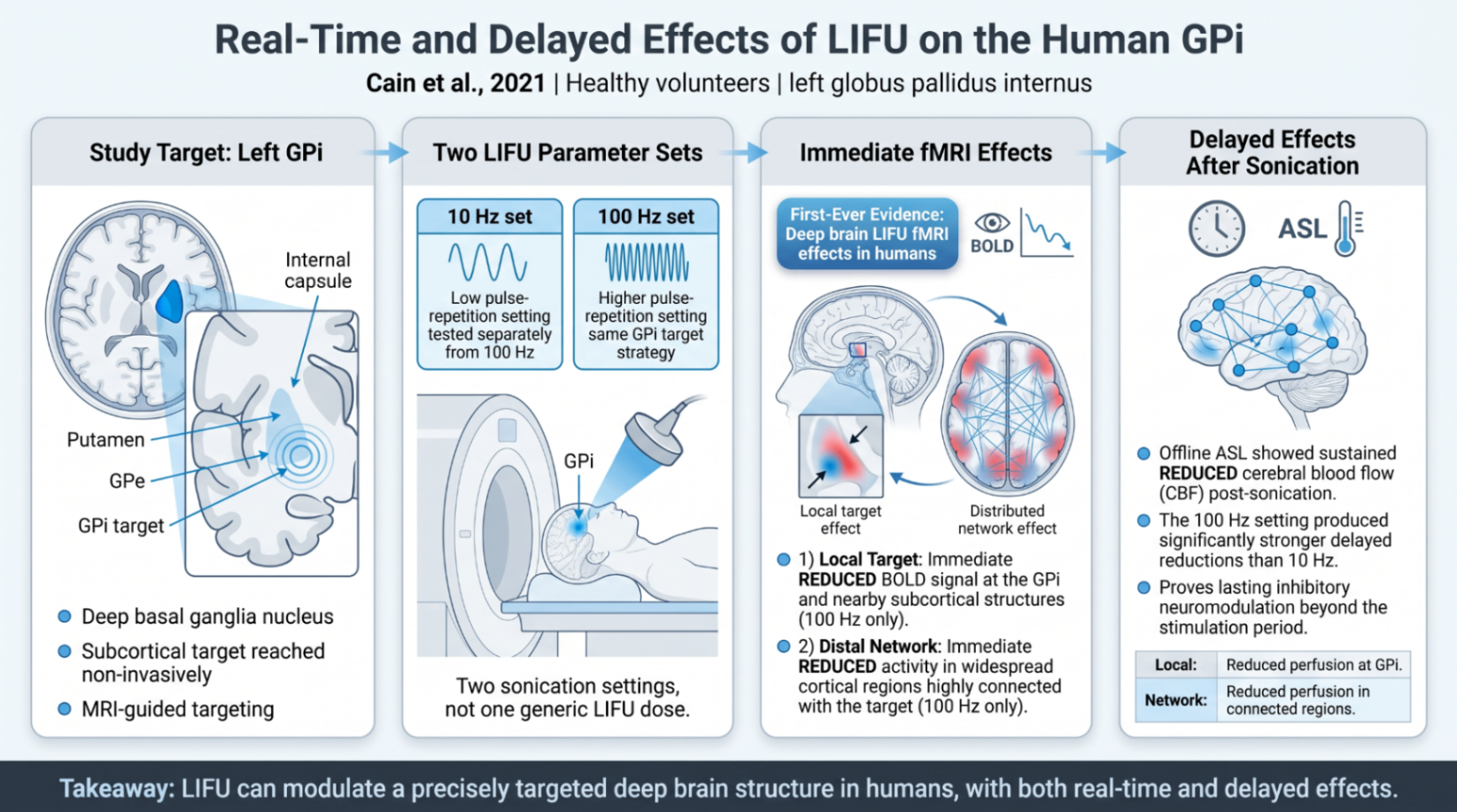
Infographic summarizing target, parameters, and immediate vs delayed effects.
Full citation
Cain, J. A., Visagan, S., Johnson, M. A., Crone, J., Blades, R., Spivak, N. M., Shattuck, D. W., & Monti, M. M. (2021). Real time and delayed effects of subcortical low intensity focused ultrasound. Scientific Reports, 11(1), 6100.