How can you predict how your Focused Ultrasound Experiment will be affected by the Skull without Doing your own Simulations?
S.M.A.R.T. F.U.S: Surrogate Model of Attenuation and Refraction in Transcranial Focused Ultrasound
Cain, J. A., Visagan, S., Monti, M. M.
What's the Point?
This methods paper introduces SMART FUS, an open-source toolbox that replaces hours-long supercomputer simulations with fast, accurate estimates of how the skull distorts ultrasound. Removing this bottleneck makes transcranial focused ultrasound more accessible to more labs.
The skull distorts and weakens ultrasound as it enters the brain. To target deep regions safely, researchers need to simulate how each person's skull will bend the beam—but that normally takes hours on a supercomputer.
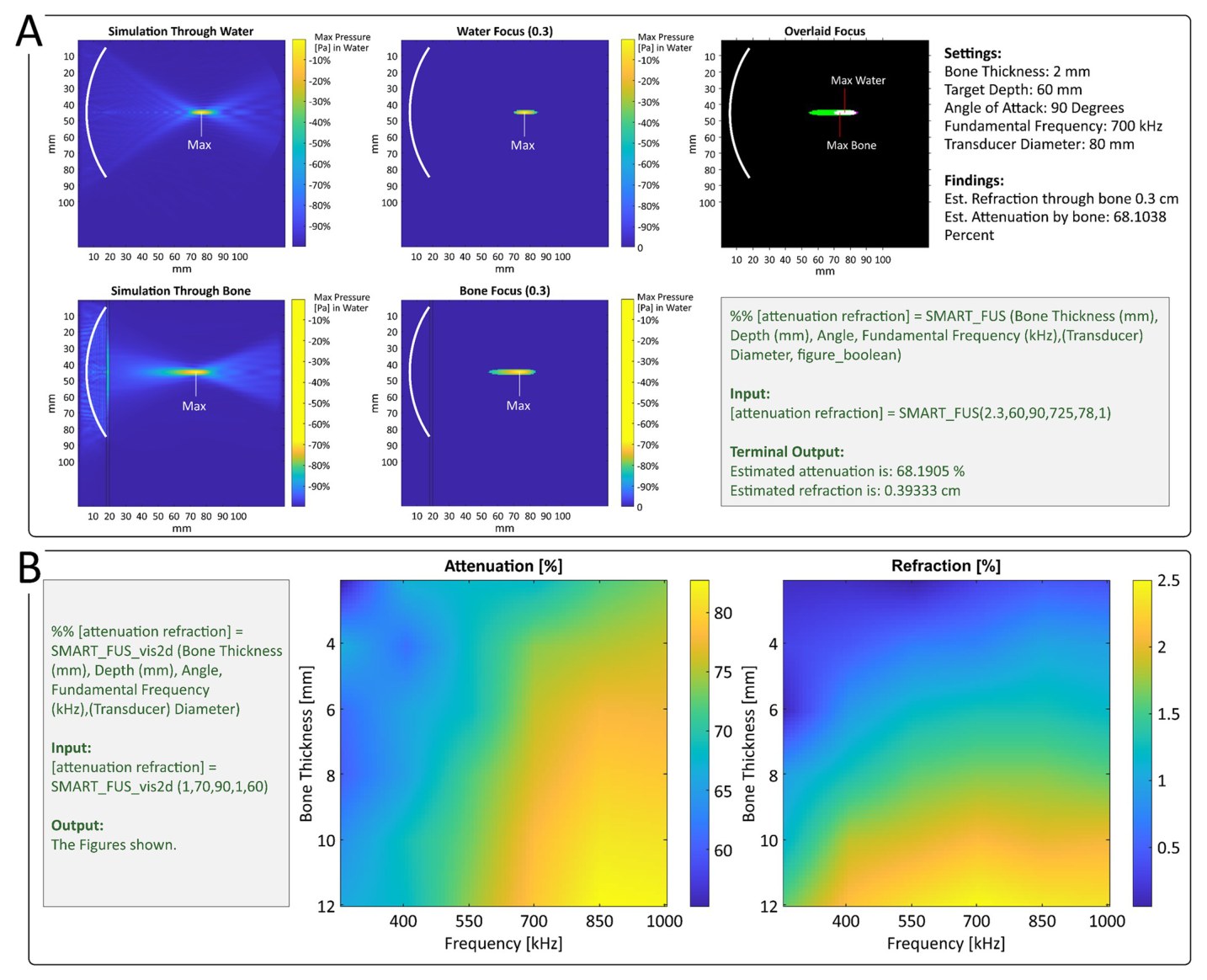
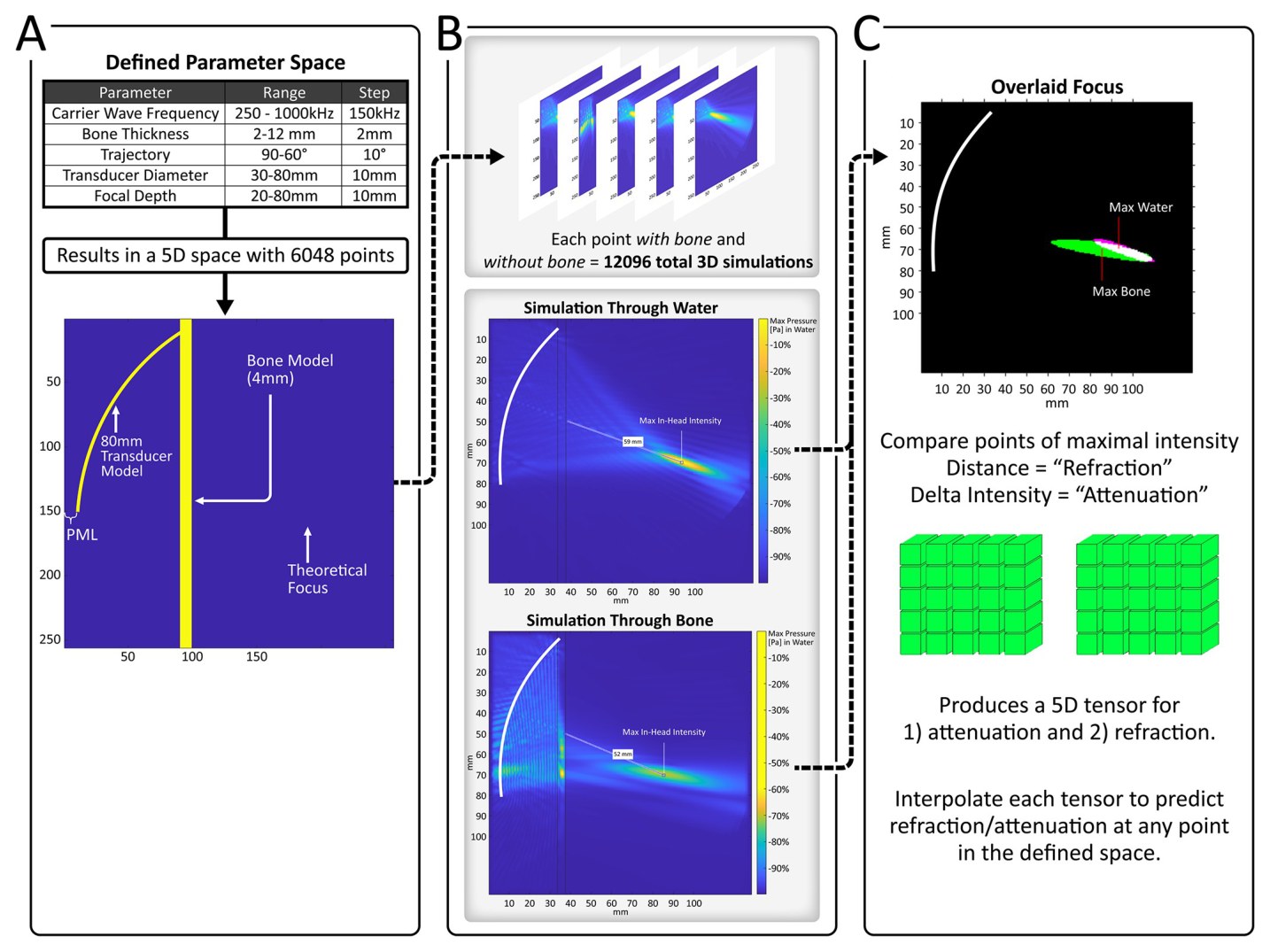
We ran over 12,000 full physics simulations across a five-dimensional parameter space (skull thickness, curvature, angle, etc.) and used them to train a fast surrogate model. The result is SMART FUS, an open-source MATLAB toolbox.
SMART FUS predicts skull-induced attenuation and refraction in seconds instead of hours, with accuracy comparable to full simulations for typical clinical parameters.
It removes a major technical barrier to adopting transcranial focused ultrasound, letting more labs plan safer, better-targeted studies without high-performance computing.
From the manuscript
Transcranial focused ultrasound neuromodulation and therapy require accurate estimates of the pressure field delivered through the skull, but full-wave simulations are computationally expensive. We introduce SMART FUS, an open-source MATLAB toolbox that uses over 12,000 k-Wave simulations across a five-dimensional parameter space to build a surrogate model of skull-induced attenuation and refraction. The tool provides fast, accurate estimates for typical clinical parameter regimes and is intended to lower the barrier to entry for research groups adopting transcranial focused ultrasound.
- Methods
- Modeling
- Focused Ultrasound
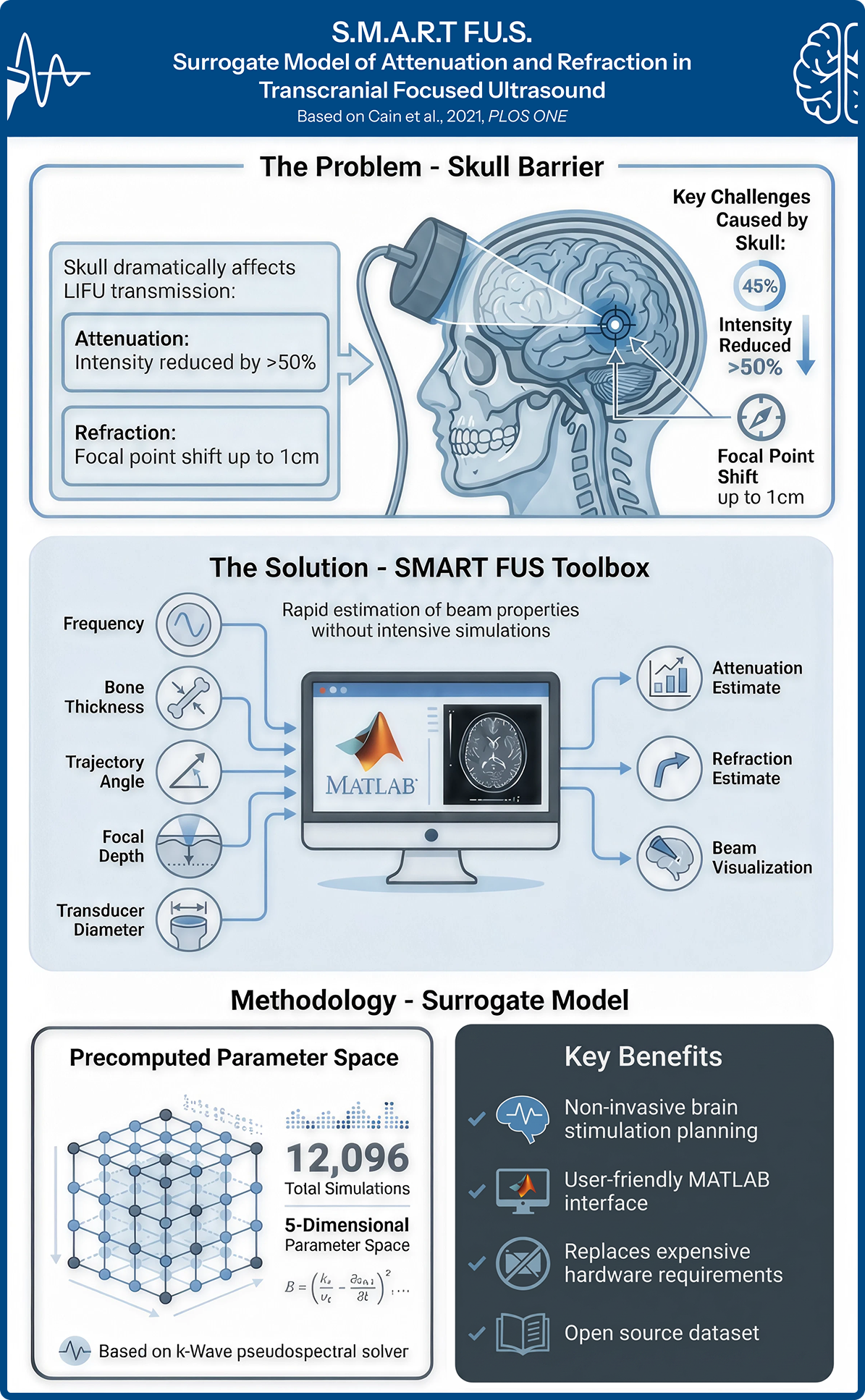
Infographic summarizing the problem, toolbox, and methodology.
Full citation
Cain, J. A., Visagan, S., & Monti, M. M. (2022). S.M.A.R.T. F.U.S: Surrogate Model of Attenuation and Refraction in Transcranial Focused Ultrasound. PLOS ONE, 17(10), e0264101.