What Happens in the Brain When Coma Patients Improve After Ultrasound?
Neural Correlates of Behavioral Recovery Following Ultrasonic Thalamic Stimulation in Chronic Disorders of Consciousness
Cain, J. A., Spivak, N., Coetzee, J., Crone, J., Johnson, M., Lutkenhoff, E., ..., Monti, M. M.
What's the Point?
This trial tracks behavior and brain activity across repeated sessions of thalamic ultrasound in chronic post-coma patients. It links acute neural changes to later clinical gains, helping identify who may benefit most from this intervention.
People with chronic disorders of consciousness (long-term coma-like states) have very few treatment options. Earlier work suggested MR-guided thalamic ultrasound could help some patients recover behavior.
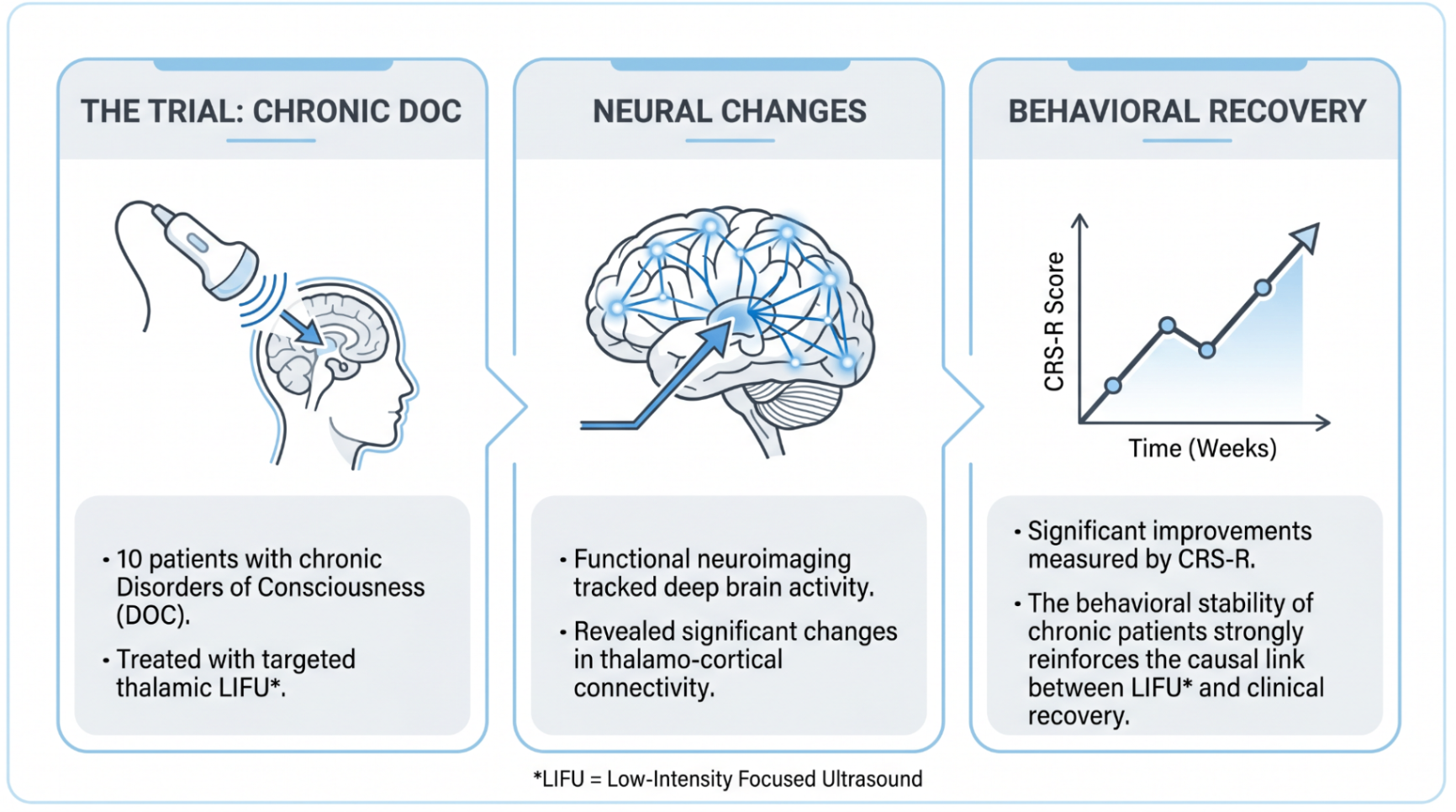
We report the full-cohort trial of thalamic ultrasound in chronic post-coma patients. Behavior was tracked with the CRS-R across repeated sonication sessions, alongside fMRI measures of thalamic and cortical activity and connectivity.
A subset of patients showed linear behavioral improvements across repeated sonication cycles. Acute changes in thalamic and striatal BOLD activity and in thalamo-cortical connectivity predicted who would go on to recover.
For the first time, we can link a brain-based signature of an ultrasound treatment to behavioral recovery in disorders of consciousness—crucial groundwork for future sham-controlled and personalized trials.
From the manuscript
This full-cohort trial extends earlier proof-of-concept work by combining behavioral (CRS-R) and neuroimaging (fMRI) measures across repeated cycles of MR-guided thalamic focused ultrasound in chronic disorders of consciousness. A subset of patients exhibited linear improvements in CRS-R scores across sonication cycles, and acute changes in thalamic and striatal BOLD activity and thalamo-cortical connectivity were linked to subsequent behavioral recovery. Please see the full preprint for detailed methods and results.


- Disorders of Consciousness
- Clinical Trial
- Focused Ultrasound
Infographic summarizing the trial, neural changes, and recovery.
Full citation
Cain, J. A., Spivak, N., Coetzee, J., Crone, J., Johnson, M., Lutkenhoff, E., ... & Monti, M. M. (2025). Neural Correlates of Behavioral Recovery Following Ultrasonic Thalamic Stimulation in Chronic Disorders of Consciousness. medRxiv.