Can Ultrasound Deepen Meditation in Experienced Practitioners?
Facilitating Meditation with Focused Ultrasound Neuromodulation: A First Investigation in Experienced Practitioners
Cain, J. A., Brandmeyer, T., Simonian, N., Sanguinetti, J., Young, S., Sacchet, M., Reggente, N.
What's the Point?
This proof-of-concept study asks whether focused ultrasound can deepen meditation in long-term practitioners by targeting brain regions linked to advanced contemplative states. It provides the first sham-controlled test of ultrasound as a tool to probe and potentially support meditation.
Experienced meditators can enter deep states of awareness that novices rarely reach. Brain-imaging work implicates the posterior cingulate cortex, caudate, and anterior insula—but no one had tried to directly modulate these regions to change meditative depth.
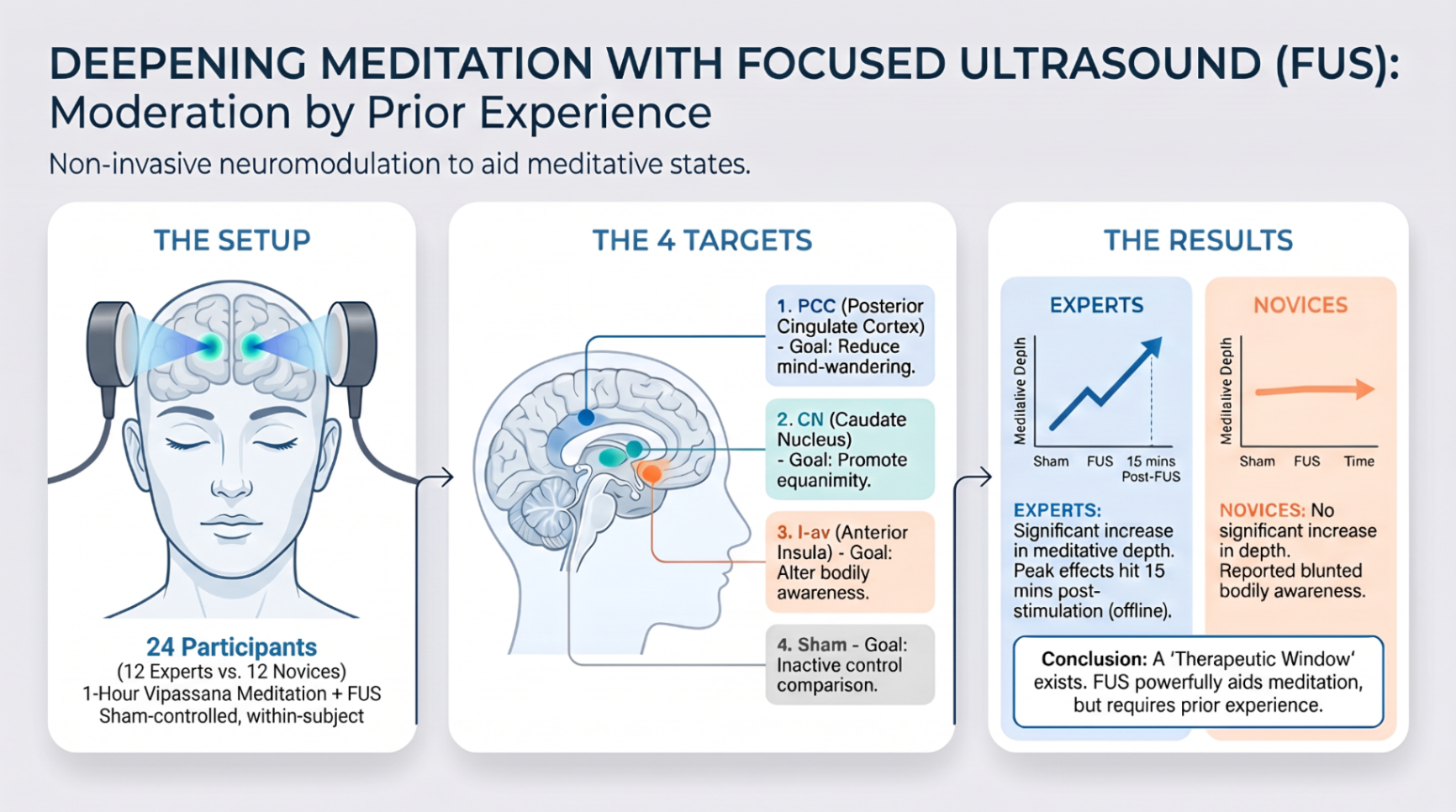
Long-term meditators completed sessions of guided practice before and after focused ultrasound aimed at each of these three regions, plus a sham condition. Depth was tracked with in-session probes and self-report.
Caudate-targeted ultrasound selectively deepened meditation in expert practitioners, with effects peaking a few minutes after stimulation—suggesting a causal role for striatal circuitry in advanced contemplative states.
This is the first sham-controlled test of ultrasound as a way to facilitate meditation. It opens a route to studying (and potentially supporting) advanced contemplative states in a rigorous, neuroscientifically-grounded way.
From the manuscript
This preprint investigates whether transcranial focused ultrasound can modulate the depth of meditation in experienced practitioners by targeting brain regions implicated in advanced contemplative states—the posterior cingulate cortex, caudate, and anterior insula—within a sham-controlled design. Caudate-targeted sonication selectively enhanced self-reported meditative depth in experts, with effects peaking in the minutes following stimulation. Please see the full preprint for detailed methods and results.

- Meditation
- Focused Ultrasound
- Consciousness
Infographic summarizing the setup, targets, and results.
Full citation
Cain, J. A., Brandmeyer, T., Simonian, N., Sanguinetti, J., Young, S., Sacchet, M., & Reggente, N. (2025). Facilitating Meditation with Focused Ultrasound Neuromodulation: A First Investigation in Experienced Practitioners. PsyArXiv (preprint, under review).