Can Ultrasound Stimulation Induce Coma Recovery?
Ultrasonic Thalamic Stimulation in Chronic Disorders of Consciousness
Cain, J. A., Spivak, N. M., Coetzee, J. P., Crone, J. S., Johnson, M. A., Lutkenhoff, E. S., Real, C., Buitrago-Blanco, M., Vespa, P. M., Schnakers, C., Monti, M. M.
What's the Point?
This case study reports the first 3 chronic patients recovering from coma who received focused ultrasound neuromodulation in the first clinical trial of its kind. Their relative stability as chronic patients increases our confidence that observed recoveries were due to the intervention rather than natural variability.
People in chronic disorders of consciousness can persist for years with minimal responsiveness. Deep brain stimulation of the central thalamus has helped in rare surgical cases, but a non-invasive option had never been tested.
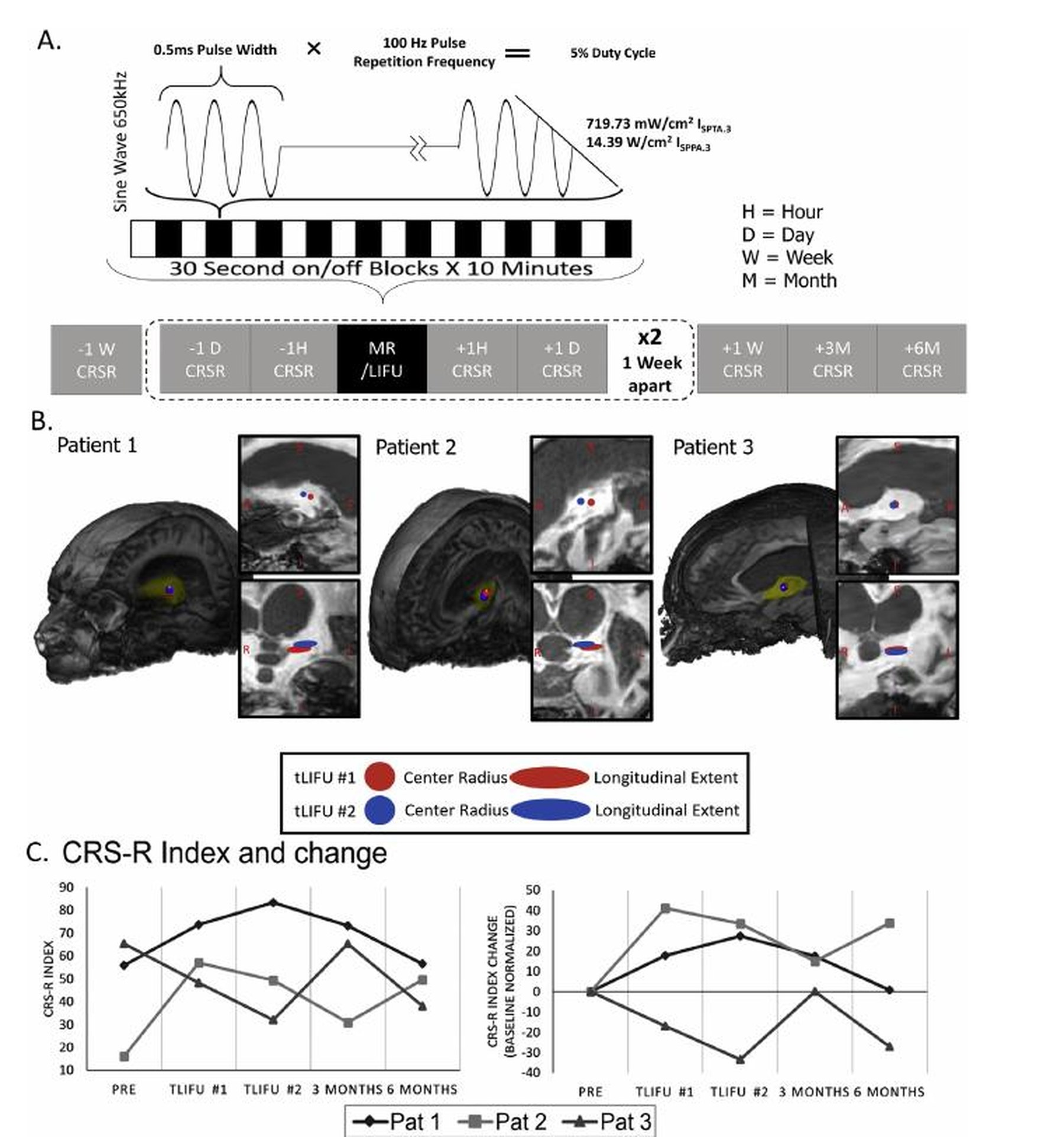
The world's first clinical trial of MR-guided focused ultrasound aimed at the central thalamus in chronic post-coma patients. Behavior was tracked with the CRS-R for an extensive baseline period, before and after each sonication, and at several time-points days, weeks, and months following this candidate intervention.
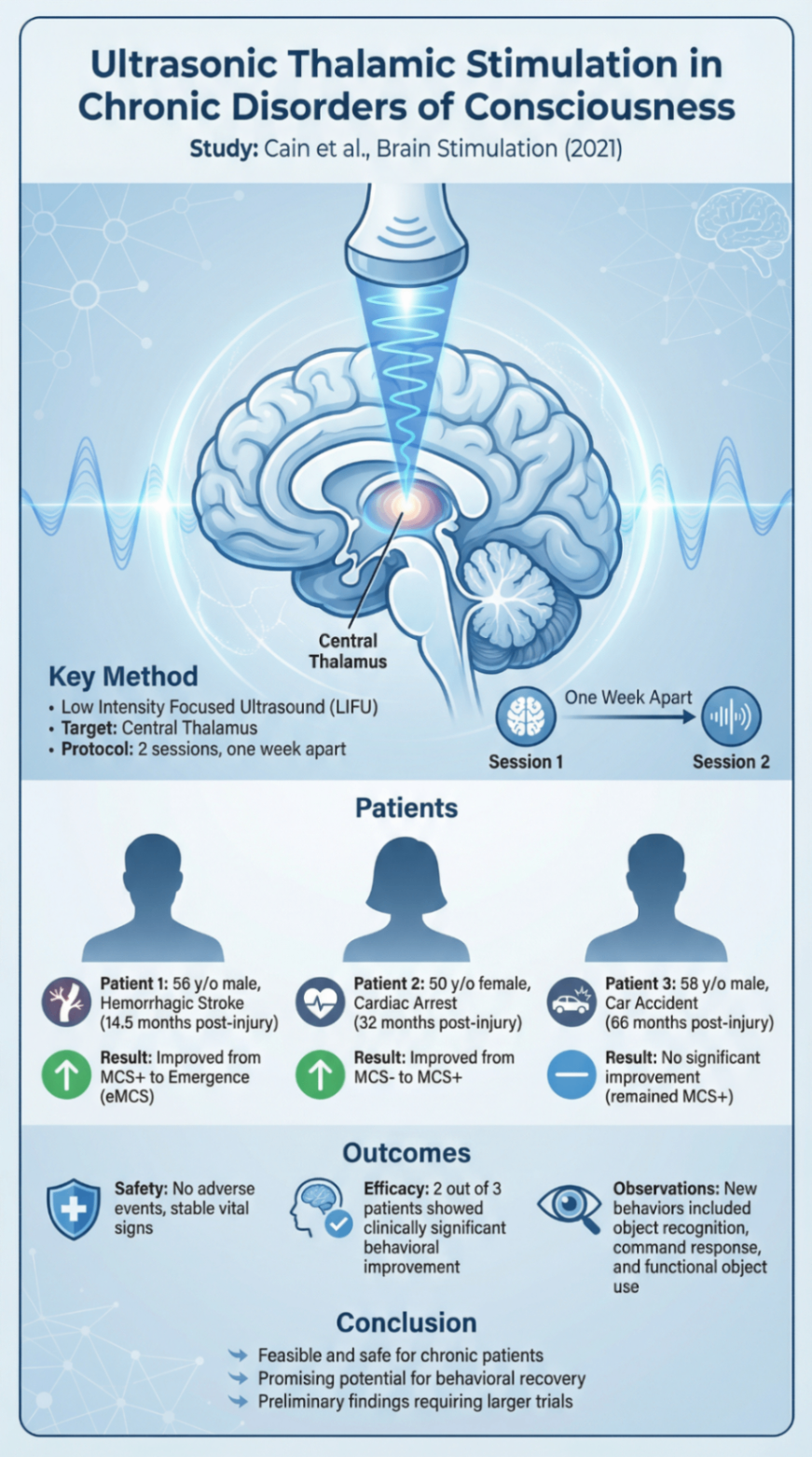
The procedure was feasible and safe. Two (of 3 total) patients in this early case-study showed meaningful behavioral recovery after non-invasive thalamic ultrasound. In these 2 patients who did recover, recovery included regaining the ability to communicate, new behaviors unseen prior to stimulation, and a shift into higher-functioning clinical diagnoses. One patient even regained, for roughly 1-week, full consciousness as defined by gold-standard clinical assessments, demonstrating accurate two-way communication for the first time in his 5-years since injury-a finding that was backed-up by his wife and primary care-giver.
This early case-report established non-invasive thalamic ultrasound as a candidate therapy for disorders of consciousness and motivated the larger-scale, sham-controlled trials that followed.
From the manuscript
We report the first clinical trial applying MR-guided low-intensity focused ultrasound to the thalamus in chronic disorders of consciousness. The procedure was feasible and safe, and a subset of participants showed meaningful recovery of communication and improved Coma Recovery Scale-Revised scores, establishing non-invasive thalamic neuromodulation as a candidate therapy that warrants sham-controlled trials.
- Disorders of Consciousness
- Clinical Trial
- Focused Ultrasound
Infographic summarizing the method, patients, and outcomes.
Full citation
Cain, J. A., Spivak, N. M., Coetzee, J. P., Crone, J. S., Johnson, M. A., Lutkenhoff, E. S., Real, C., Buitrago-Blanco, M., Vespa, P. M., Schnakers, C., & Monti, M. M. (2021). Ultrasonic thalamic stimulation in chronic disorders of consciousness. Brain Stimulation, 14(2), 301–303.