Can Focused Ultrasound Change Behavior by Stimulating Deep Brain Regions?
Behavioral Effects of Targeting the Central Thalamus and Pulvinar with Transcranial Ultrasound Stimulation in Healthy Volunteers
Cain, J. A.*, Hopkins, E., et al.*Co-first authors
What's the Point?
This study tests whether focused ultrasound aimed at two nearby deep-brain regions—the central thalamus and the pulvinar—can selectively change alertness and visual attention in healthy volunteers. Separating these roles helps clarify how the human thalamus supports consciousness and attention.
Deep inside the brain, the central thalamus helps you stay awake and pay attention. Two nearby sub-components of the thalamus—the central thalamus and the pulvinar—are thought to do very different jobs, but there was no safe way to test this directly in healthy humans.
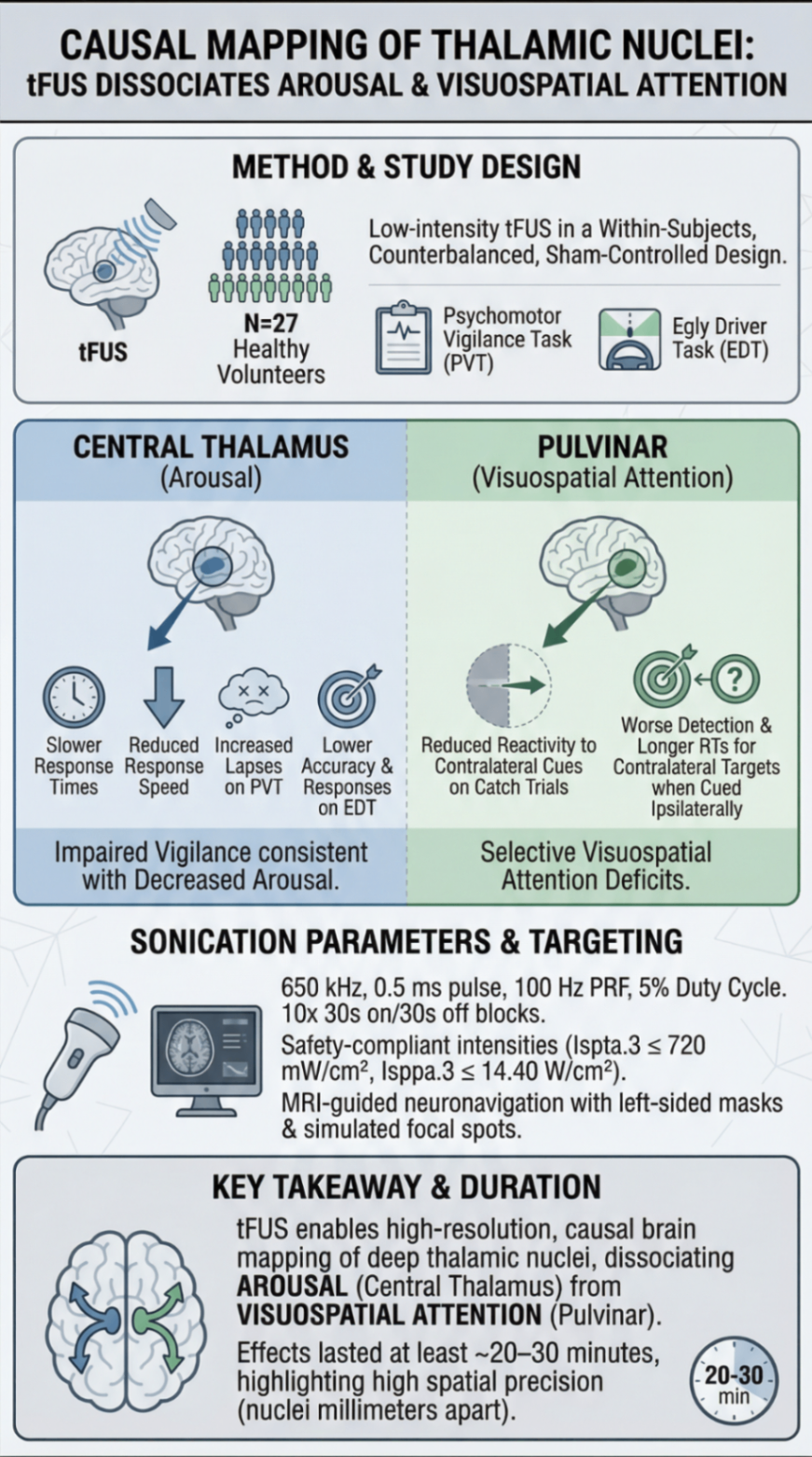
We used low-intensity transcranial ultrasound stimulation (TUS), which focuses sound waves through the skull to gently modulate a small deep brain region. Twenty-seven healthy volunteers completed three sessions of a sustained-attention task and a visual-attention task before and after ultrasound aimed at the central thalamus, the pulvinar, or a sham condition.
Targeting the central thalamus made people measurably drowsier: they reacted more slowly and had more attentional lapses. Targeting the pulvinar preserved alertness but impaired detection of objects on the opposite side of space.
Ultrasound can noninvasively and causally map deep brain structures in healthy people, cleanly separating arousal from visuospatial attention. This opens a new window on how the deep brain builds attention and consciousness, with future clinical applications for disorders of consciousness or attention.
From the manuscript
Using low-intensity focused transcranial ultrasound stimulation, we test the causal roles of the central thalamus in arousal and the pulvinar in visuospatial attention in the healthy human brain. In a within-subjects, counterbalanced design, 27 healthy volunteers (two females) completed a vigilance task (Psychomotor Vigilance Task) and a visuospatial attention task (Egly-Driver Task) before and after sham, central thalamic, and pulvinar sonication. Targeting the central thalamus slowed responses and increased lapses in attention during the vigilance task, indicating reduced arousal. Pulvinar sonication reduced (and slowed) responses to visual stimuli presented contralaterally, suggesting a disruption of contralateral visuospatial attention. Here, we provide causal evidence linking the pulvinar to visuospatial attention and the central thalamus to arousal in the healthy human brain and demonstrate that ultrasound can elicit distinct behavioral changes in healthy volunteers when delivered to close but functionally distinct thalamic regions, underscoring its potential as a tool for noninvasive brain mapping.


- thalamus
- central thalamus
- pulvinar
- visual attention
- vigilance
- arousal
- alertness
- consciousness
- transcranial ultrasound stimulation
Infographic summarizing methods, results, and takeaway.
Full citation
Cain, J. A., Hopkins, E., et al. (2025). Behavioral Effects of Targeting the Central Thalamus and Pulvinar with Transcranial Ultrasound Stimulation in Healthy Volunteers. bioRxiv.